martes, 7 de abril de 2015

MOZAMBIQUE ROWUMA LNG PLANT GOVERNMENT CONCEDES TO COMPANY DEMANDS

Anadarko -The Deepwater Millennium drillship

Following negotiations with the American and Italian multinational companies, Anadarko and ENI, the Council of Ministers approved the decree-law establishing the legal and contractual regime applicable to the Liquefied Natural Gas Project (LNG) for areas 1 and 4 of the Rovuma

Basin on the 28th November 2014. Our analysis focuses on four main issues: fiscal stability, the exchange rate regime, unification of the gas-fields and local labor/content. Companies managed to secure their objective of 30 years of fiscal stability, even though Parliament authorized stability in only 10-year increments, by agreeing to a small increase in the production tax in the 2030s and another increase in the 2040s.


lunes, 6 de abril de 2015

Ministries of Energy and Mineral Resources Merge Present New Investment Opportunities

Mozambique Industry: Ministries of Energy and Mineral Resources Merge Present New Investment Opportunities

Anadarko in Mozambique
With Mozambique’s Ministry of Resources and Energy now merged, the country has taken another major step towards its 2025 vision for gas and power development. As the former Deputy Finance Minister, His Excellency Dr. Pedro Couto will clearly have a plan to promote sustainable partnerships for trade with a focus on the country’s balance sheet; however, will there be extra emphasis on regional gas sharing and power sector investment?
With exports of liquefied natural gas projects scheduled to start in 2019, Mozambique has high expectations for its gas sector. Furthermore, the prospects for renewable energy look promising with more than 23TW of possible renewables projects coming online.
However, despite over US$ 3.238 billion of investment in power projects in 2014, the transmission bottleneck continues to impact the social and economic development of the region, threating the bankability of power projects in development. Eskom, African Development Bank, IFC and Southern African Power Pool are amongst the partners addressing transmission and regional distribution to accelerate the country’s industrial development.
EnergyNet (http://www.energynet.co.uk) will host the 4th Annual Powering Africa Mozambique in Maputo from the 7th-8th May 2015 (http://www.poweringafrica-mozambique.com). Participants will be given the opportunity to connect with over 150 senior participants including power developers, financiers, DFIs and transmission partners to discuss market developments, investment opportunities and the viability of project finance in line with the country’s vision 2025 objectives.
Respected stakeholders and major investors confirmed to attend include Eskom, Sasol, AIIM, ACWA Power, SMBC, European Investment Bank, African Development Bank and Tractebel Engineering. Visit http://www.poweringafrica-mozambique.com for more information.
Topics will focus on the new Ministry’s strategies for encouraging investment, natural resources and generation topics in support of Mozambique’s plans to escalate electricity access in line with its future gas economy.

jueves, 2 de abril de 2015

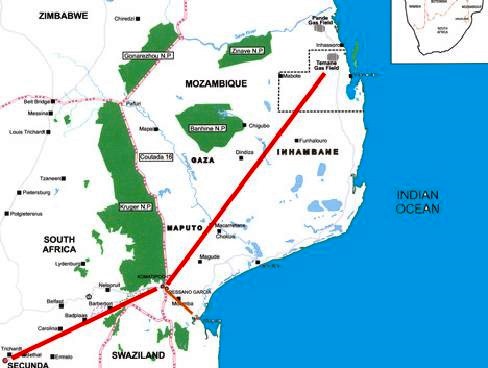
Temane-Secunda Pipeline Expansion Complete

Mozambique Oil & Gas: Temane-Secunda Pipeline Expansion Complete

Temane - Secunda gas Pipeline
Loop Line 1 is already complete
The Republic of Mozambique Pipeline Investments Company (ROMPCO) recently announced the successful completion of a project to expand the existing 865 km of gas pipeline from the CPF at Temane in Mozambique to Secunda in South Africa. The project involved the installation of a pipeline in parallel to the existing pipeline starting from the CPF and running 128 km where it connects back into the main pipeline.
Named Loop Line 1, the expansion project increases ROMPCO’s gas transmission capacity. Loop Line 1 was built to transport gas to customers at the energy hub of Ressano Garcia in Mozambique, including the Central Térmica de Ressano Garcia (CTRG) gas-to-power facility, the Matola Gas Co. and Empresa Nacional de Hidrocarbonetos(ENH). This expansion in capacity enables the generation of more than 400 MW of power at Ressano Garcia. The project marks another milestone in enabling further in-country monetization of gas for Mozambicans.
ROMPCO is a JV between Sasol, Companhia Mocambiçana de Gasoduto S.A., and South African Gas Development Co. (SOC) Ltd. It owns the 865-km pipeline through which the gas purchased from Mozambique is transported to South Africa and to Ressano Garcia in Mozambique. It is a cornerstone of the natural gas project that saw Mozambican gas monetized for the first time.(Africa Petroleum)

lunes, 30 de marzo de 2015

Gas distribution network in Maputo almost complete

Mozambique Oil & Gas: Gas distribution network in Maputo almost complete

To perform the technical and commercial feasibility study,  SACOIL Holdings established a joint development agreement with Mozambican nas outh Africa public institutions
Gas distribution network in Maputo
The work, which began in December 2014, is included in the second phase of the Maputo and Marracuene gas distribution project and is intended to install a 14.6 km pipeline from Zimpeto, outside the Mozambican capital, to the village of Marracuene.
In the first phase, the consortium, owned by Mozambican company ENH and South Korea’s Kogas, built a 62-kilometre network, a project estimated to cost more than 35 million euros, which is already in operation.
In 2009, the Mozambican government awarded a concession to ENH to sell and distribute gas in the city of Maputo and district of Marracuene and the Mozambican state invited the Kogas to form the consortium responsible for the project, which was eventually funded by South Korea. (macauhub/MZ)

Analysts call for investigation into charges ENI and Guebuza

ON DW Africa: Analysts call for investigation into charges ENI and Guebuza

The Deepwater Millennium drillship  works on an Anadarko Petroleum Corp. project in the Rovuma Basin off the coast of Mozambique.
The Deepwater Millennium drillship works on an Anadarko Petroleum Corp. project in the Rovuma Basin off the coast of Mozambique.
A suspected case of corruption and influence peddling involving the Italian oil giant ENI and the former Mozambican President Armando Guebuza is shaking Maputo. It is expected that the PGR open an investigation to ascertain the veracity of the case as reported by DW Africa.
Since February that Mozambican publications Canalmoz and Savana are reporting on the case, using as source the newspaper “Il Fatto Quotidiano”. According to the Italian daily, former President Armando Guebuza have offered to ENI oil company, a tax exemption on the sale of their shares to the China National Petroleum Corporation (CNPC) in exchange for unspecified favors. The deal will not have been treated directly with the Mozambican state, through the Mozambique Tax Authority, as is supposed, but with the former head of state.
The revelations came as a result of an investigation into international corruption against Paolo Scaroni, former manager of the Italian oil company, carried out by Milan prosecutors. According to telephone recordings in the power of Italian PGR, Guebuza has yet offered a heavenly land in Bilene, in southern Mozambique, “with the possibility of a DUAT (Right to Use and Land Utilization) valid for 40 years.”
Eyes are now turned to the Prosecutor General’s Office (PGR) in Mozambique. Ericino of Salema, a lawyer and journalist, author of the article on the subject in Savan weekly, says there is sufficient evidence to the PGR starts investigating the case. “The company, the former head of state himself and, to some extent, the Tax Authority will have something to say.”
Clarification is in everyone’s interest
The journalist also said that, under the United Nations Convention against Corruption, ratified by Mozambique in 2006, it is possible that the Offices of the two countries to work together to clarify the deal – the Mozambican counterpart express interest.
“If requested, the Attorney General’s Milan Republic has a duty to provide all relevant information,” says Ericino of Salema.
“The former head of state, like any citizen, enjoys the presumption of innocence. But because it was the highest magistrate of the nation, is in our interest as Mozambicans, and also of his interest, to clarify what is said. ”
Will the Prosecutor investigate this case?
Borges Nhamire, a researcher at the Center for Public Integrity (CIP), points out that so far there is no solid data confirming the involvement of Guebuza in this case. However, we need to investigate.
DW Africa tried to contact the Mozambican Attorney, unsuccessfully, to know whether to open an investigation.
Nhamire says you can not stand idly by waiting for the PGR investigate accusations.
“In all major cases involving influential people in politics and economics, the prosecution has not brought the expected results.” Nhamire gives the example of “case involving the citizen Momade Bachir Sulemane, who was charged from the outside to be involved in drug trafficking. The Attorney investigated but the results are not very convincing.”
In Mozambique, the credibility of the justice organs is very low. It is considered inefficient and partial. Its leaders are appointed by the President.
Therefore, in the case involving Armando Guebuza and ENI, once again, the CIP researcher does not expect “compelling results for Mozambicans.” Borges Nhamiri believes that “civil society should carry out its parallel investigation.”
Attorney General appointed by former president
The current Attorney General’s Office, Beatriz Muchili, was appointed by President Armando Guebuza. This can not influence the opening of an investigation into former President?
“This point is central,” says the lawyer and journalist Ericino of Salema. “When we are appointed to a function of these, there are some political trust involved. Nothing can move without the Attorney General’s Office authorizes the Central Office for Combating Corruption to proceed with any investigation. But I hope that her performance may be professional, in the interests of the Mozambican state.”
According to the Mozambican press, the state will have lost $ 900 million in the transaction between ENI and the Chinese company CNPC. The total value of the transaction was 4.2 billion USD. The State should have embedded 1.3 billion, but only got 400 million.(DW)

domingo, 29 de marzo de 2015

El gran desafío de Mozambique

El gran desafío de Mozambique

La inestabilidad política amenaza el futuro petrolero del país africano

La Baixa, mercado municipal de Maputo (Mozambique). / GUIZIOU FRANCK


Dicen los que van a Maputo, la capital de Mozambique, que la ciudad está que no se la reconoce. Donde hace 10 años solo había calles destrozadas, edificios despintados y tiendas cerradas, se multiplican los hoteles de lujo, los edificios corporativos, las urbanizaciones exclusivas, los restaurantes gourmet y tiendas como las de Hugo Boss. El país vive en un estado de euforia, generado por las enormes posibilidades que se le están abriendo con el descubrimiento de enormes yacimientos de gas y crudo, que empezarán a exportarse ya en 2019.
Tan fuertes son las expectativas que el presidente del luso BCP Millennium Bank, dueño del mayor banco de Mozambique, dijo hace días que "las posibilidades son infinitas". Así que, si bien sigue siendo uno de los países más pobres del mundo, Mozambique tiene todas las cartas en la mano para dejar de serlo dentro de poco: el único problema es que, para culminar esa migración hacía la prosperidad, tendrá que mantener la estabilidad política de la que ha hecho gala en los últimos 20 años, y que empezó a resquebrajarse en 2013.
De momento los expertos ven al país como uno de los mayores casos de éxito de África. Incluso antes de que emergieran todos esos manás de gas y petróleo, ha estado creciendo en torno a tasas del 8% en lo que va de siglo. Entre 2006 y 2013 dobló el tamaño de su economía, desde los 7.096 a los 15.630 millones de dólares, igual que su renta per cápita, que pasó de los 670 a los 1.100 dólares. Para 2015 se prevé que el PIB crezca un 7,5%. Parte de ese dinamismo se debe a la subida de las exportaciones de carbón (es uno de los grandes productores del mundo), a la construcción y a los proyectos de infraestructuras en marcha.
Pese al crecimiento, el país sigue siendo pobre y apenas ha cambiado su configuración social y económica. El principio de abundancia que se nota en Maputo está totalmente ausente en las zonas rurales, donde sigue viviendo la mayor parte de la población, normalmente en un régimen de subsistencia. El país sigue a la cola del Índice de Desarrollo Humano de la ONU, asolado por catástrofes que no tendrían tanto impacto de contar con los equipamientos necesarios, como las inundaciones del año pasado, que desplazaron a miles de personas, o la epidemia de cólera que afecta a 5.000 personas. Además, el modelo de desarrollo centrado en los minerales y los hidrocarburos no ha tenido impacto sobre la población, ya que genera muy escaso empleo. Para remediarlo, el Gobierno quiere promover industrias intensivas y modernizar la agricultura, que sigue empleando al 70% de los mozambiqueños. Para eso necesita mejorar el sistema educativo con el fin de salvar la notoria falta de preparación de la mayoría de los ciudadanos.
Se prevé, sin embargo, que todo cambiará al final con la explotación de gas y el crudo, que ascenderá al país al club de los países emergentes y doblará su PIB en cuatro o cinco años para colocarse en 2025, según el Banco Mundial, en el grupo de los países de ingresos medios. Se espera que las reservas conocidas de gas, en la cuenca del Rovuma, en la frontera con Tanzania, conviertan a Mozambique en uno de los 10 primeros productores y tercer exportador mundial. La puesta en marcha de las tareas de exploración le exigirá al país africano la adecuación de sus infraestructuras, ahora casi inexistentes. Se calcula que Mozambique invertirá 40.000 millones de dólares en el próximo decenio para modernizar sus carreteras, puertos y aeropuertos.
Maputo anunció recientemente la pavimentación, en el marco de su plan 2015-2019, de unos 2.100 kilómetros de carreteras y la reparación de otros 2.800 kilómetros. El país está invirtiendo también en centrales eléctricas y redes de distribución de gas y electricidad, un total de 3.240 millones de dólares el año pasado. Está construyendo cinco nuevas presas hidroeléctricas y ampliando la gigantesca central de Cahora Bassa: un total de 3.600 megavatios (más que la potencia instalada actual) y una inversión de 7.000 millones de dólares. Esta apuesta era necesaria ya que en los últimos años el consumo de electricidad ha crecido a un ritmo del 80% anual. Además, el 70% de la electricidad producida en Cahora Bassa se exporta a Zambia y Sudáfrica.
Estos proyectos están provocando la llegada de ríos de dinero. En 2013 Mozambique (con 25 millones de habitantes) recibió 4.800 millones de dólares en inversión directa exterior, más que Nigeria (siete veces más poblada), que recibió 4.600 millones. La mayor parte de estos proyectos están siendo financiados por organismos internacionales o por empresas, en el caso de la exploración de materias primas o las infraestructuras. Un tercio del presupuesto público de Mozambique, según The Economist, es cubierto por organismos internacionales como el Banco Mundial, que aportará este año cerca de 200 millones de dólares para que el Gobierno de Filipe Niusi —en el poder desde 2014— pueda hacer frente a sus gastos.
Pero el mayor desafío que tiene que vencer el país es el de la estabilidad política. Durante 20 años, Mozambique se ha beneficiado de cierta armonía entre los dos principales partidos. Pese a que el Frelimo (en el poder) y la Renamo (en la oposición) se enfrascaron en una guerra civil de 15 años (1977-1992), han sido capaces de convivir tras la firma del acuerdo de paz en 1994, basado en un reparto en las tareas de Gobierno.
Pero la eclosión del gas y el crudo en la economía ha hecho que la Renamo sienta que ha sido marginada de los beneficios y amenace con un rebrote de la guerra civil. El país vive ahora en un cierto compás de espera. La Renamo quiere la autonomía de las provincias del norte (Manica, Sofala, Tete, Zambezia, Nampula y Niassa), donde están las reservas de gas y la mayor parte de su electorado.
La caída de los precios de los hidrocarburos no ayuda a la evolución de la situación política. Las firmas energéticas están más cautelosas con los nuevos proyectos y exigen mejores condiciones. Los dos últimos procesos de adjudicación no tuvieron éxito. Sin embargo, los que están en marcha siguen y producirán mucha riqueza. Nadie cree que la sangre vaya a llegar al río. La llegada de un tercer partido, MDM (Movimiento Democrático de Mozambique), dificultará la hegemonía del Frelimo y le obligará a buscar acuerdos. Los inversores siguen llegando.

jueves, 26 de marzo de 2015

New dams add 3,600 megawatts of power production in Mozambique

New dams add 3,600 megawatts of power production in Mozambique

Construction of five new hydroelectric dams in Mozambique and the expansion of the Cahora Bassa facility will increase the potential of the country’s energy production by around 3,600 megawatts, involving investments of over US$7 billion.
Power consumption in Mozambique is increasing by an average annual rate of 82 megawatts (about 14 percent), according to the Ministry of Planning and Development (MPD), and expansion of the energy sector is one of Mozambique’s greatest economic challenges, given the growing industrial requirements across the country.
It is in this context that in the Government 2015-20019 Five-Year Plan, which will be voted by the Mozambican parliament from the beginning of April, the government noted the priority of developing various power generation projects, some of which have already secured investors and funding.
This is the case of the Lupata Hydroelectric Facility, in Tete province, with a potential to generate 416 megawatts, which will require an investment of about US$1.072 billion, implemented by a consortium of companies including Hydroparts Holding and Cazembe Holding, both registered in Mauritius, and state power company EdM and Sonipal of Mozambique.
Also in Tete province and along the Zambezi River, the Boroma Hydroelectric Dam will have an installed capacity of 210 megawatts, and will be carried out by Rutland Holding, of Mauritius, EdM and Sonigal, which will need to invest US$572.5 million in the project.
Added together, the two projects are likely to create more than 4,000 jobs, according to the Mozambique Centre for Investment Promotion, through which the investments were made in 2014.
The guidelines for government policy also give priority to starting construction of the Mphanda Nkuwa dam, about 70 kilometres northeast of the city of Tete and 61 kilometres southeast of the Cahora Bassa dam, a project with a generation potential of 1,500 megawatts, which has an estimated cost of US$4.2 billion.
Already awarded to Camargo Corrêa (40 percent), of Brazil, Insitec (40 percent) of Mozambique, and EdM (20 percent), the dam should be completed in 2017, according to the Integrated Programme of Investments of the MPD, revised in June 2014.
In this document, the MPD also outlined the construction of the Lúrio Hydroelectric Plant in Nampula, citing a generating capacity of 180 megawatts and an investment cost of about US$480 million, but for now, the project has no known investors .
The situation is similar with the Alto Malema Hydroelectric dam, also in Nampula province, with a potential to generate 60 megawatts, which is included in the five-year government programme.
The government has also noted the progress of the second phase of Cahora Bassa (HCB), the project also called Cahora Bassa Norte, construction of which will increase in the power generation capacity of the project by 1,250 megawatts, from 2,075 megawatts at the moment.
The project is estimated to cost about US$700 million, according to estimates from the MPD.
HCB’s shareholder structure includes the Mozambican state with a 92.5 percent stake, while Portuguese power grid company REN, which itself is 25 percent owned by the State Grid Corporation of China (SGCC), owns the remaining share of 7.5 percent.
Mozambique currently has a production capacity of about 2,300 megawatts of power an HCB is the facility that produces the largest amount of electricity in the country.
Much of the dam’s production (about 75 percent) is exported, particularly to Zimbabwe and South Africa, a country whose national power company Eskom, has an agreement with HCB for the annual purchase of 1,100 megawatts, valid until 2029. (macauhub/MZ)