Mostrando entradas con la etiqueta MozOil. Mostrar todas las entradas

sábado, 20 de octubre de 2018

Oil Explorers to Spend ‘Hundreds of Millions’ in Mozambique

Oil Explorers to Spend ‘Hundreds of Millions’ in Mozambique

 Updated on 

viernes, 31 de julio de 2015

Seven submitted bids for the hydrocarbon licensing round in Mozambique - Government

Seven international consortia submitted bids on the fifth research contest and gas production released in October by the Mozambican government, according to a media release by the National Oil Institute (INP).

According to the note, announcing that the tender has ended on Thursday, in the running for the exploration and production of hydrocarbons are seven consortia led by companies Total (France), Eni (Italy), ExxonMobil (USA), Troisade and Delonex (both from England), Rosneft (Russia) and Sasol (South Africa).

The competition focuses on 15 blocks in northern, central and southern Mozambique, with a total length of 74,402 square kilometres.

INP indicates that it will announce the tender results within three months, after assessing the impact on health and environment, technical expertise, financial capacity and economic advantages to the Mozambican state proposed by each of the competing consortia.

Gas reserves estimated at 200 trillion cubic feet of natural gas have been discovered in recent years in Mozambique in research carried out by consortia led by Italian Eni and the US Anadarko in the Rovuma basin, northern Mozambique.

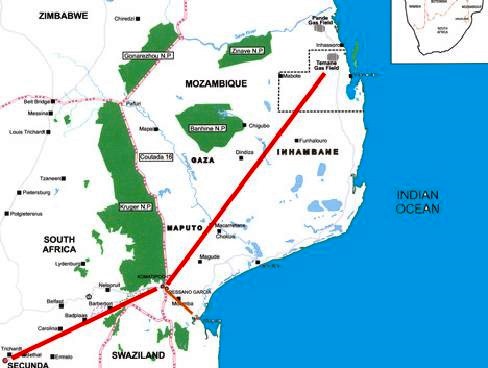
The South African multinational Sasol is exploring natural gas in Pande and Temane in southern Mozambique, having built a 850 kilometre pipeline linking the gas fields to the company's industrial complex in South Africa.


Source: Lusa

Photo: INP

viernes, 24 de julio de 2015

Mozambique's First Offshore Licensing Round Closes August 31st

Mozambique's First Offshore Licensing Round Closes August 31st

Mozambique’s First Offshore Licensing Round Closes August 31st
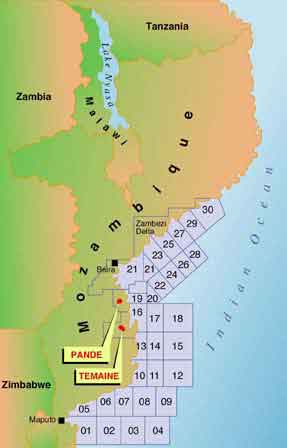
Empresa Nacional de Hidrocarbonetos de Mocambique (ENH) launched Mozambique's first offshore licensing round March 31st with 14 of its 31 blocks in the Mozambique Indian Ocean aquatory on offer, ranging from Blocks 16 and 17 offshore Temane and Blocks 19 and 20 offshore Pande, northward along the coast to just south of Angoche. The round closes August 31st.
Vintage data and data acquired by Western Geophysical in 1998-99 is available. In addition, ENH recently commissioned Elf Aquitaine to conduct both seismic and geophysics synthesis work over this largely unexplored sector near the Zambeze Delta, where water depths range from 1,800 to 3,000 meters.
Edited by Dev George

jueves, 9 de abril de 2015

Refinery on Horizon for Ethiopia

Africa Oil & Gas: Refinery on Horizon for Ethiopia

An Oil Refinary Sample
An Oil Refinery Sample
An Ethiopian oil marketer, National Oil Ethiopia, is looking to establish a refinery in the Horn of Africa country, eliminating some of the government’s burden of importing costly refined petroleum products from international sources like India and countries in the Gulf region.
When, or if, the refinery moves forward it is slated to have a capacity to produce 20,000 to 30,000 bpd. It was not revealed where the financing for the refinery would come from.(Source: Africa petroleum)

jueves, 2 de abril de 2015

Temane-Secunda Pipeline Expansion Complete

Mozambique Oil & Gas: Temane-Secunda Pipeline Expansion Complete

Temane - Secunda gas Pipeline
Loop Line 1 is already complete
The Republic of Mozambique Pipeline Investments Company (ROMPCO) recently announced the successful completion of a project to expand the existing 865 km of gas pipeline from the CPF at Temane in Mozambique to Secunda in South Africa. The project involved the installation of a pipeline in parallel to the existing pipeline starting from the CPF and running 128 km where it connects back into the main pipeline.
Named Loop Line 1, the expansion project increases ROMPCO’s gas transmission capacity. Loop Line 1 was built to transport gas to customers at the energy hub of Ressano Garcia in Mozambique, including the Central Térmica de Ressano Garcia (CTRG) gas-to-power facility, the Matola Gas Co. and Empresa Nacional de Hidrocarbonetos(ENH). This expansion in capacity enables the generation of more than 400 MW of power at Ressano Garcia. The project marks another milestone in enabling further in-country monetization of gas for Mozambicans.
ROMPCO is a JV between Sasol, Companhia Mocambiçana de Gasoduto S.A., and South African Gas Development Co. (SOC) Ltd. It owns the 865-km pipeline through which the gas purchased from Mozambique is transported to South Africa and to Ressano Garcia in Mozambique. It is a cornerstone of the natural gas project that saw Mozambican gas monetized for the first time.(Africa Petroleum)

lunes, 30 de marzo de 2015

Analysts call for investigation into charges ENI and Guebuza

ON DW Africa: Analysts call for investigation into charges ENI and Guebuza

The Deepwater Millennium drillship  works on an Anadarko Petroleum Corp. project in the Rovuma Basin off the coast of Mozambique.
The Deepwater Millennium drillship works on an Anadarko Petroleum Corp. project in the Rovuma Basin off the coast of Mozambique.
A suspected case of corruption and influence peddling involving the Italian oil giant ENI and the former Mozambican President Armando Guebuza is shaking Maputo. It is expected that the PGR open an investigation to ascertain the veracity of the case as reported by DW Africa.
Since February that Mozambican publications Canalmoz and Savana are reporting on the case, using as source the newspaper “Il Fatto Quotidiano”. According to the Italian daily, former President Armando Guebuza have offered to ENI oil company, a tax exemption on the sale of their shares to the China National Petroleum Corporation (CNPC) in exchange for unspecified favors. The deal will not have been treated directly with the Mozambican state, through the Mozambique Tax Authority, as is supposed, but with the former head of state.
The revelations came as a result of an investigation into international corruption against Paolo Scaroni, former manager of the Italian oil company, carried out by Milan prosecutors. According to telephone recordings in the power of Italian PGR, Guebuza has yet offered a heavenly land in Bilene, in southern Mozambique, “with the possibility of a DUAT (Right to Use and Land Utilization) valid for 40 years.”
Eyes are now turned to the Prosecutor General’s Office (PGR) in Mozambique. Ericino of Salema, a lawyer and journalist, author of the article on the subject in Savan weekly, says there is sufficient evidence to the PGR starts investigating the case. “The company, the former head of state himself and, to some extent, the Tax Authority will have something to say.”
Clarification is in everyone’s interest
The journalist also said that, under the United Nations Convention against Corruption, ratified by Mozambique in 2006, it is possible that the Offices of the two countries to work together to clarify the deal – the Mozambican counterpart express interest.
“If requested, the Attorney General’s Milan Republic has a duty to provide all relevant information,” says Ericino of Salema.
“The former head of state, like any citizen, enjoys the presumption of innocence. But because it was the highest magistrate of the nation, is in our interest as Mozambicans, and also of his interest, to clarify what is said. ”
Will the Prosecutor investigate this case?
Borges Nhamire, a researcher at the Center for Public Integrity (CIP), points out that so far there is no solid data confirming the involvement of Guebuza in this case. However, we need to investigate.
DW Africa tried to contact the Mozambican Attorney, unsuccessfully, to know whether to open an investigation.
Nhamire says you can not stand idly by waiting for the PGR investigate accusations.
“In all major cases involving influential people in politics and economics, the prosecution has not brought the expected results.” Nhamire gives the example of “case involving the citizen Momade Bachir Sulemane, who was charged from the outside to be involved in drug trafficking. The Attorney investigated but the results are not very convincing.”
In Mozambique, the credibility of the justice organs is very low. It is considered inefficient and partial. Its leaders are appointed by the President.
Therefore, in the case involving Armando Guebuza and ENI, once again, the CIP researcher does not expect “compelling results for Mozambicans.” Borges Nhamiri believes that “civil society should carry out its parallel investigation.”
Attorney General appointed by former president
The current Attorney General’s Office, Beatriz Muchili, was appointed by President Armando Guebuza. This can not influence the opening of an investigation into former President?
“This point is central,” says the lawyer and journalist Ericino of Salema. “When we are appointed to a function of these, there are some political trust involved. Nothing can move without the Attorney General’s Office authorizes the Central Office for Combating Corruption to proceed with any investigation. But I hope that her performance may be professional, in the interests of the Mozambican state.”
According to the Mozambican press, the state will have lost $ 900 million in the transaction between ENI and the Chinese company CNPC. The total value of the transaction was 4.2 billion USD. The State should have embedded 1.3 billion, but only got 400 million.(DW)

miércoles, 18 de marzo de 2015

Five countries most affected by the oil price crash

FROM OILPRICE.COM: Five countries most affected by the oil price crash

Globl Oil and Gas Industry
Since June 2014, global oil prices have dropped by more than 50%. The drop could strongly affect the economic and political stability of these five oil exporting countries.
Oil prices make winners and losers. In general, oil importers will gain from low prices, while most oil exporters will suffer. Still, there are differences. While the United States, Norway, and the Gulf States can protect themselves with diversified economies and high hard currency reserves, the oil shock could bring some countries to the verge of economic default and political crisis.
Venezuela
Venezuela entered the period of low oil prices with an already frail economy ruined by the more than a decade-long socialist regime of Hugo Chavez and his successor Eduardo Maduro. The oil price slump significantly worsened the country’s already failing economy.
More than 90 percent of Venezuela’s exports and hard currency reserves depend on oil, and with the price of oil 50 percent down, the country is close to a default.
Standard & Poor’s is the last in a line of rating agencies that downgraded Venezuela’s credit rating to junk status and the country’s currency is experiencing a constant devaluation trend. At the same time, the inflation is expected to rise to 200 percent this year and the economy to shrink by 7 percent.
Consequently, the Maduro government is forced to cut subsidies introduced by the Chavez regime, and to liberalize the economy in accordance with the global realities in the oil markets, which could not only cause strong economic shocks and public outcry, but also trigger a swift regime change.
Nigeria
Africa’s largest economy is under increased pressure after the sudden drop in oil prices in the last eight months. This is the second blow for one of the continent’s largest oil exporter’s after the shale boom virtually brought to a halt its oil exports to the United States.
The country’s budget breakeven price of oil for 2015 is $122, according to Deutsche Bank estimates. Moreover, oil exports constitute more than 70 percent of Nigeria’s budget income and 90 percent of its foreign exchange.
As a result, the Nigerian naira has lost the fifth of its value against the US dollar since June 2014. In addition, security instability caused by the Boko Haram campaign in the predominantly Muslim-populated north of the country and the political turmoil ahead of the presidential elections exposebitter divisions along the ethnic and regional lines that could further destabilize the country.
Iraq
Iraq is particularly affected by the oil prices slump, as the country is struggling to bring its oil production to pre-war levels, rebuild the war-torn country and wage a new war against the Islamic State.
The country’s finances depend exclusively on oil exports, and oil price volatility strongly affects its economy. At the moment, Iraq is effectively increasing its oil production in order to offset the slump in oil prices.
The country’s oil production currently stands at around 4 million barrels per day, and is expected to rise by additional 550,000 barrels. However, despite the recent budget revision tailored to a $56 per barrel price, the fiscal deficit for 2015 is still forecast at $22 billion.
Following the improvement in relations between Baghdad and the Kurdish autonomous region, along with the improved situation since the removal of Prime Minister Nouri al-Maliki last August, the political and security situation has made a significant turn for the better in recent months.
Nonetheless, the fight against ISIS, which holds great swaths of Northern Iraq, and continuous friction between Iraq’s political factions is draining the country’s finances and threatening its political stability.
Russia
Russia is a politically stable country and the Putin regime enjoys unprecedented levels of public support. The country’s hard currency reserves are at high levels and the Russian oil industry is more resilient to oil prices volatility compared to its international peers. Thus, Russia will not see major political upheavals in the short term.
On the other hand, the oil shock and Western sanctions have hit the Russian economy and itsconsumers hard. The country’s economy has been under strong pressure since the introduction of sanctions almost a year ago, and the oil price drop only added to the pain, as the Russian 2015-2017 budget draft is based on the $100 per barrel price.
The inflation is currently at 17 percent, the rouble slumped by 44 percent in the past 12 months, and the economy is expected to shrink by 3 percent in 2015, according to an IMF forecast.
In the long run, with Russia expected to continue to wage war in Ukraine and consequently suffer from an additional set of Western sanctions, along with a prolonged period of low oil prices, both the economic and political situation in the country might deteriorate.
Iran
Iran has been a major victim of both the ban on oil exports imposed by the international community and the falling oil prices.
Years of international isolation have taken a toll on Iran’s economy, but the sudden drop in oil prices is threatening to plunge the country into a full-blown recession. This will have a direct impact on the general population, already impoverished by the years of sanctions, as well as on investment into Iran’s tarnished infrastructure.
Although it is unlikely that the low oil prices will affect the stability of the regime in Teheran, the current situation, in the midst of the nuclear programme negotiations, might stir the debate between liberals and conservatives within Iran’s leadership over the future course of the country and its relations with the international community.

jueves, 18 de septiembre de 2014

East Africa Neighbors Close To Picking Consultant For Oil Export Pipeline

Africa Oil & Gas: East Africa Neighbors Close To Picking Consultant For Oil Export Pipeline

OIL AND GAS INDUSTRY
Kenya, Uganda and Rwanda are in the final stages of deciding on a consultant to oversee building a pipeline to pump the region’s new oil bonanza to the coast for export, a senior Kenyan energy ministry officials said on Thursday. In June, the three countries invited bids for a consultant to oversee a feasibility study and initial design for the construction of a 1,300-km (808-mile) oil pipeline to transport crude to the Kenyan coast.
“We are in the final stage of negotiating with the consultant who will do a feasibility study and the front end engineering design for a crude oil pipeline which should run from Hoima to coastal region of this country,” Joseph Njoroge, principal secretary at the Ministry Energy and Petroleum told an east African oil and gas conference.
“Very soon, early next month,” Martin Heya, commissioner of petroleum at the same ministry said of the award timing.
Njoroge said the consultant would be required finish the study within five months of the award.
In addition to the pipeline, the consultant would be required to supervise the construction of a fibre optic cable from Hoima in Uganda through the Lokichar basin in northwest Kenya to Lamu, and tank terminals in Hoima, Lokichar and Lamu.
The project will also involve the construction of a 9-km pipeline from the Lamu tank terminal to an offshore mooring buoys.
Kenya’s energy ministry said earlier this year the aim of having a single consultant for the whole project was to ensure consistency in the quality of the whole pipeline.
East Africa has become potentially lucrative for international oil firms after Kenya and Uganda’s commercial oil finds and discoveries of gas off the coast of Tanzania and Mozambique.
Tullow Oil and Africa Oil, which control blocks in Kenya, have estimated discoveries in the South Lokichar basin at 600 million barrels, a level experts say is enough to make a pipeline viable even without Uganda.
In neighbouring Uganda, the government estimates its crude reserves at 3.5 billion barrels.
Njoroge put the estimated crude oil recoverable reserves at about 1 billion barrels from the tertiary Rift Valley Basin, and about 1 trillion cubic standard feet of natural gas in the Anza Basin, and about 750 billion cubic feet of gas in the Lamu Basin, all in Kenya.(Edited by Reuters)

miércoles, 10 de septiembre de 2014

A Question: Why the sudden rush into Africa?

A Question: Why the sudden rush into Africa?

Image
An Answer: It’s the oil!
Mozambique, Kenya, Libya, Uganda and Nigeria are thousands of miles removed from that swirl of European tension known as Ukraine, but as drama unfolds in Eastern Europe, their destinies could be closely aligned.
In essence, the more Russian President Vladimir Putin puts the grip on Russian gas prices, the more Western powers, from Nato to the US, feel squeezed and desperate enough to look for oil elsewhere. Africa fits a nice profile for that. Suddenly, there’s a new sense of urgency on the continent, with the US stepping up its military and economic engagement post-haste since Putin made his Crimean power grab.
Before Putin could move to checkmate the West on the geopolitical chess map, President Barack Obama moved a few pieces to the Motherland. It’s an interesting gamble, considering Africa has less than 10 per cent of proven global oil reserves. Yet, in the search for alternative sources of energy, the potential returns of intervention in Africa are fairly fast and enormous.
Where the Middle East, cradle of oil booms, is volatile and where Shale Country USA is still in its infancy, Africa presents a quick-fix solution for petroleum hungry Western countries that don’t have time for renewable-energy cars to fully penetrate their markets.
Oil-spilling BP can tell you all about it, “project[ing] Africa will experience the world’s fastest regional energy demand growth [with] combined oil and gas production in Africa between today and 2035.”
If BP has its eyes on Africa, best believe everyone else does. Within a month of Crimea, additional US “special forces” troops ended up in Uganda to augment a hundred already there in a hunt for war-lusting Lord’s Resistance Army leader Joseph Kony. And to top that, the Pentagon sent in four freshly minted V-22 Osprey tilt-rotor hybrids to show we mean business.
“Please note that the deployment of these aircraft and personnel does not signify a change in the nature of the US military advisory role in this effort. African Union-led regional forces remain in the lead, with US forces supporting and advising their efforts,” Daniel Travis, a US Embassy spokesman in Uganda, deadpanned several days ago.
But the sudden speed between Putin’s power act and the move of well-armed US troops to Uganda and elsewhere in Africa is more than just a nice humanitarian play. Critical strategic interests in Africa are suddenly on a front burner in the race for energy.
Uganda, is part of an emerging and fast-growth East Africa Federation that includes Kenya, Tanzania, Rwanda and Burundi. As a recent Stratfor analysis noted “[n]ew oil and gas exploration projects, along with the potential establishment of a manufacturing base in East Africa, have created an interest in pipeline projects to carry natural gas and crude oil to export markets or refineries.”
Renewed strategic positioning in Africa is, of course, nothing new. The George W. Bush administration was dropping $5 billion a year into HIV/AIDS and malaria-prevention programmes, essentially softening the landscape for the eventual expansion of Africom, the US military command for Africa.
Hence, it was no surprise to find American planes blasting holes in Libya, drone bases in far-flung places like Niger, Djibouti, Burkina Faso and South Sudan, and US intelligence supporting French troops in Mali. Folks like Moammar Qadhafi needed to get out of the way, and now it’s US naval ships stopping renegade Libyan oil tankers from sending black market fuel to North Korea.
The headline fight against rising Islamic terrorist tides in Africa is a good pitch story. But the lesser known — yet more important — story is the continental energy rush gradually unfolding in Africa. Western powers, already irritated by China’s aggressive entry into African markets — highlighted by billions of dollars in investment and a $200 million “gift” to build a shiny new African Union headquarters in Addis Ababa, Ethiopia — are stepping up their game before the rising Asian power dominates the whole thing.
That’s happened quite fast between slow increases in US troops on African soil to the presence of more than 2,000 French troops patrolling the war-torn Central African Republic. And just a few weeks ago, the EU nervously announced the commitment of an additional 1,000 troops, which struck many as odd, given Europe’s current preoccupation with Russian troops on its doorstep. Folks seem awfully pressed to stabilise that region, which neighbours Uganda and isn’t all that far away from Nigeria — another African country that accounts for five per cent of US oil imports.
In essence, Africa is becoming refrontiered, the next — but already charted — neocolonial play with subtle shades of humanitarianism and economic growth to make it look good. Make no mistake about it: there are real geopolitical intentions at work. Hunting down warlords and preventing Rwanda genocide redux is, of course, needed foreign policy common sense.
But these are belt-tightening times for governments and their militaries (including ours). No one’s investing in Africa just to get good PR and a UN shout-out.
—By arrangement with The Root-The Washington Post

jueves, 16 de enero de 2014

Mozambique due to become oil producer in 2014

JANUARY 6TH, 2014 FEATURES

Mozambique is due this year to become an oil producing country and significant progress is also expected to be made in natural gas and coal production, according to the Economist Intelligence Unit.


A small oil discovery next to the Temane gas field, in Inhambane province (south), will allow South African petrochemical company Sasol to launch oil production this year, said the EIU’s latest report on the Mozambican economy, to which Macauhub had access.

“The oil field is the first to produce oil commercially in Mozambique, where so far there have only been viable natural gas discoveries,” the report said.

The project will produce around 2,000 barrels of oil per day, which is a small amount commercially-speaking, but makes it possible to “diversify Mozambique’s export base,” it noted.

As well as this, Sasol’s representatives have already said that oil reserve estimates may be increased, as exploration activities are already underway in the area.

According to the Oil and Gas Journal, Mozambique has around 4.5 trillion cubic feet of proven natural gas reserves, but until the beginning of last year had no oil reserves at all.

The country has extensive onshore and offshore sedimentary basins containing natural gas, most of which has yet to be explored, as well as significant coal reserves, which are considered to be the biggest in the world.

William Telfer, an oil and gas specialist told DW Africa that the discovery “is very viable” and that 100 similar wells were the equivalent of Angola and Nigeria’s production.

“It’s not small, it’s very good. And we are soon going to hear about new discoveries that will increase the amount of wells,” said the specialist.

“Gross domestic product will increase. We have an excellent Finance minister and excellent deputy minister. A very strong staff. Mozambique is prepared to start exploring large quantities of oil,” he said.

Despite the announcement, the Economist kept its estimates for economic and export growth in the 2014-2018 period unchanged, as they already take into account substantial investments in the extractive industries and greater weight of exports.

Along with this Sasol is increasing production as its gas fields in Pande and Temane which is “welcome news for the nascent Mozambican energy sector,” and a “sign of confidence,” from an important foreign investors at a time that is sensitive in terms of both politics and security.

Sasol is investing in a number of areas, including increasing the capacity of its gas pipeline to South Africa (US$184 million) and a gas-fired power plant at the Ressano Garcia border (US$246 million).

The EIU for this year points to growth of the Mozambican economy of 6.5 percent, rising to 7.3 percent this year and 7.6 percent in 2015.

The industrial sector is expected to make the biggest contribution to economic growth over the next two years: 9 percent growth in 2014 and 14 percent in 2015. (macauhub)

miércoles, 18 de diciembre de 2013

First commercial crude from Mozambique seen in 2014 -Sasol

First commercial crude from Mozambique seen in 2014 -Sasol

CAPE TOWN Thu Nov 28, 2013 8:31am EST

RELATED TOPICS

Nov 28 (Reuters) - Mozambique's first commercial production and sale of crude oil is set for next year from a small but profitable inland oil field at Inhassoro, a senior official at South African operator Sasol said on Thursday.
"It's a small development, but it is a sign perhaps there is more," Ebbie Haan, SasolPetroleum International's managing director, told Reuters on the sidelines of an African oil and gas conference.
"If we were to develop (the field) with one or two wells in the first phase, we would be talking about multiples of 1,100. So if we drill two wells, you probably get 2,000 barrels a day," he added.
Recent discoveries of gas and coal have triggered billions of dollars in investment in the former Portuguese colony.
Haan said Sasol planned to invest around $2.4 billion in Mozambique for a variety of projects until 2018, when the southern African nation is expected to export its first cargoes of liquefied natural gas.
Sasol, the first mover in oil and gas exploration in Mozambique, has conducted extended well testing on the Inhassoro oil rim and produced over 236,000 barrels of light oil to the end of March this year as part of an appraisal programme.
Haan said commerciality was declared earlier this year on the Inhassoro G6 and G10 oil reservoirs in the PSA block, and the natural gas fields in Temane G8 and Temane East are also viable.
Sasol is the world's top gas-to-liquid fuel producer, with a plant in Qatar and others planned in United States and Canada. The company aims to take advantage of Mozambique's plans to use gas reserves for power, fertilizers and methanol.
The company is preparing to expand an existing Mozambique gas processing facility and a pipeline to South Africa.
Sasol is also exploring offshore Mozambique, where some of the world's largest gas discoveries in the last decade have been made.
"We are looking at the upcoming bid round, and we have onshore exploration blocks left, so we have a good funnel of opportunities," Haan said.
Mozambique is poised to launch its fifth oil and gas bidding round in 2014, a government official said this week.

Mozambique's image as a stable African success story recently has been blotted by shootings and ambushes in the centre and north, carried out by fighters from the Renamo opposition movement, which fought a 1975-1992 war with the ruling Frelimo party. (Editing by Ed Stoddard and Jane Baird)